

Lead pipe replacement has been national news for a few years now, and if you own a home in Lowell, you may have already received a notice about the city’s service line inventory program. That kind of mail can feel alarming or it can feel abstract, especially when the city’s own water quality reports consistently show low lead numbers. What many homeowners don’t realize is that a clean municipal report and safe water at your tap are two different things. For homes built before 1986, sometimes well before, the risk isn’t abstract at all.
We’ve been serving homeowners across Massachusetts and New Hampshire since 2003, and every member of our plumbing staff holds a Master Plumber license. Water quality questions come up often, and in Lowell’s older neighborhoods, the answers depend less on what the city’s treatment plant is doing and more on what’s inside the walls and under the street in front of a house. In this article, we discuss what you need to know.
Why Lowell’s Older Homes Are More Likely to Have Lead Plumbing
Federal law didn’t require lead-free solder for copper pipe joints until 1986. Before that year, lead solder was standard in residential construction, which means any home with original plumbing from before that date may have lead at every soldered joint throughout the supply lines. The older the home, the more joints there are and the more surface area there is for water to pick up lead as it sits overnight.
The issue doesn’t stop at solder. Brass faucets and valves manufactured before January 2014 were legally permitted to contain up to 8 percent lead under federal standards. A stricter “lead-free” definition took effect that year, capping lead content in wetted surfaces at 0.25 percent. A kitchen faucet that looked brand new in 2010 could still be leaching measurable amounts of lead today.
Lowell’s housing stock makes this more than a theoretical concern. The Belvidere Hill Historic District contains 128 structures built mostly between 1845 and 1945. The South Common Historic District includes roughly 30 structures reflecting mid-19th century construction. Triple-decker neighborhoods throughout the city follow similar timelines. These homes predate every federal restriction on lead in plumbing by decades.
The City’s Water Report Doesn’t Tell You What’s Happening at Your Tap
The Lowell Regional Water Utility’s most recent published lead monitoring round, conducted in 2025, showed a 90th percentile result of 0.015 mg/L. That’s a genuinely good number, and it reflects real work: LRWU treats its water with zinc orthophosphate, a corrosion inhibitor that forms a protective mineral film inside the pipe and keeps lead from dissolving into the water as it travels to the meter.
The problem is what happens after the meter. Lead almost never enters drinking water from treated municipal supply. It enters on the customer’s side through a lead service line between the meter and the home’s foundation, through lead solder inside the home, or through older brass fixtures at the point of use. A Consumer Confidence Report measures lead at sample sites across the distribution system. It doesn’t test the water at your kitchen tap, and it can’t tell you whether your 1920s triple-decker has lead solder throughout.
LRWU’s ongoing service line inventory is identifying pipe materials across the system, as required under state and federal rules. But that inventory tracks utility-owned pipe up to the meter. It doesn’t inspect or confirm the materials inside a home’s interior plumbing. That gap is the homeowner’s to close.
Massachusetts’ Replacement Timeline Is Quite Short
Most national coverage of lead pipe replacement is within 10 years of the EPA’s final rule under the Lead and Copper Rule Improvements. Massachusetts has its own timeline, and it’s shorter. Mass DEP’s public health goal is to replace lead and galvanized service lines within five years of the inventory date, or as soon as possible. Galvanized steel pipe matters here because it can trap lead particles deposited inside it over years of contact with a lead service line, releasing them slowly even after the lead pipe itself is gone.
When LRWU discovers a lead service line during normal operations or through the inventory program, the utility replaces the utility-owned portion up to the water meter at no charge to the resident. What it doesn’t cover is the homeowner-side line running from the meter to the foundation, or any interior plumbing. Those remain the resident’s responsibility, and in most cases, they represent the longer run of pipe and the greater exposure risk for the people inside the house.
What to Do If You Live in an Older Lowell Home
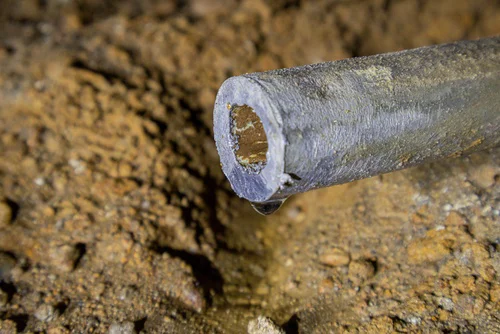
There are two practical steps you can take before calling anyone. The first is a scratch test on the pipe entering your home near the water meter or where it comes through the basement floor. Scratch the surface with a key or flat-head screwdriver. Lead is soft and will show a bright silver-gray color; copper will reveal an orange tint; galvanized steel is harder and stays dull gray. This tells you what material the entry pipe is made from, but it doesn’t tell you what’s in the water.
The only reliable way to confirm whether lead is reaching your tap is laboratory testing. A first-draw sample, collected from a tap that hasn’t been used for at least six hours, captures the water that’s been sitting in contact with your pipes overnight. Comparing that result to a flushed sample collected after running the tap for a few minutes can tell you where in the system the lead is coming from. If the first-draw number is elevated and the flushed number drops sharply, the source is likely inside the home. If both numbers stay similar, the issue may be in the service line. That distinction matters for figuring out what kind of fix is actually needed.
While you’re waiting on test results or scheduling an inspection, a few habits reduce short-term exposure. Run the cold tap for one to two minutes before using water for drinking or cooking, especially first thing in the morning. Never use hot tap water for infant formula because heat increases the rate at which lead leaches from pipes and solder. If you’re considering a point-of-use filter as an interim measure, look for certification to NSF/ANSI Standard 53 or 58. Standard 53 covers activated carbon filters rated to reduce lead; Standard 58 applies to reverse osmosis systems. A filter that isn’t certified to one of those standards isn’t confirmed to remove lead, regardless of what the packaging says.
Testing Your Home Is the Only Way to Know
Lowell’s municipal water is well-managed and consistently tests below the state action level. But a citywide 90th percentile number can’t tell you what’s coming out of the tap in a house plumbed in 1910 or soldered in 1974. Lead in drinking water is a question about individual pipes and fixtures.
If your home was built before 1986 or if you’re not sure when its plumbing was last updated, testing the water at your tap is the only way to get a real answer. Fagundes Plumbing Heating AC offers water quality testing and full plumbing assessments from licensed Master Plumbers. Call us at (978) 350-5522 to get started.